Integrating Ritual and Sacred Time in Therapy

If you’re a mental health or healthcare professional interested in ritual, ceremony, and/or the integration of a spiritual perspective into psychotherapy work, give a listen to this podcast interview/CEU course. We explore meaningful ways to honor both big and small transitions–without imposing any particular beliefs or practices. With an emphasis on discernment and cultural humility, this conversation is meant to empower and inspire clinicians, opening more creative possibility for supporting the human experience.

New Podcast CE Course Featuring Julia Aziz, LCSW-S, OIM. Rituals for Resilience: Supporting Clients Through Change Using Culturally-Attuned Ceremonies

Available on all the usual podcast platforms on Light Up the Couch.

*Find more support for professionals through individual or group consultation, the women’s group program, individual psychotherapy, and/or personal ceremony.

On helping others through troubled times that affect you too

There’s a question I’m hearing a lot, and it’s not a new one. If you’ve been emotionally supporting other people in some way, this question has been relentless in recent years:

How am I supposed to help people through a collective crisis that I am dealing with myself?

As a therapist, group facilitator, and mother of three, I know many parents, mental health practitioners, healthcare and wellness providers, caregivers, teachers, and managers who are processing double-time. I’m not going to try to answer this question; there’s already plenty of advice coming at you. These are just some thoughts for contemplation.

  • It is not our job to know better, be better, draw a silver lining around a dark cloud, or fix things just because we are in some sort of helping or leadership role. Like everyone else alive today, we’ve also never lived through this particular time in history. Lessening the pressure we put on ourselves gives room to breathe–and think more clearly.
  • It is absolutely our job to truly tend to our ourselves so we can maintain the capacity to show up for others. That may look like receiving more support, but it’s not only about care from the outside. It’s also things like how kindly we talk to ourselves. How we say no and rest. How we let our bodies express the fear or dread or rage or grief, so we don’t have to suppress or project feelings in order to keep going. 
  • Showing up with an open, listening heart in deep curiosity about the individual experience of the people we are serving matters. Collective crises do not affect all of us in the same way. Holding a space open for someone (or a group of someones) to work through their own unique experience is a real service. Especially in a time when their other loved ones may not be emotionally available.

I know many kind caregivers feeling like they have to pretend to have hope or optimism when the truth is, they are feeling the dark night. Could it be okay to orient towards “being with” rather than “doing for” others right now? I look to the trees, the river, the animals, the moon, the ancestors. I know even when we don’t want to be where we are in the cycle, we are here. 

If you need a break from people, I hope you can take one. If that’s not possible, I hope you find a refuge for your own feelings, and know that whatever you can give is enough.

With care and courage,

Julia Aziz

SUPPORTS FOR THE HELPERS

–A reminder about this Clearly Clinical podcast interview for professionals struggling with their own heavy times while still helping others

–If you could use a place to be yourself amongst other helpers, and you identify as a woman, save a spot in the next season of Release & Empower: A Group Program for Women Moving Through Change. In troubled times, it feels like such a nourishing, fortifying gift to be with women feeling, releasing, and re-centering side-by-side in nonverbal and expressive ways.

–If you’re a mental health professional wanting more clinical and professional development support, you can set up an individual consultation session or join my consultation group.

Sign up for my mailing list and some simple self-support practices here.

New podcast interview is up!

This podcast speaks to mental health, healthcare, and wellness professionals and is a little different from ones I’ve done before. Dr. Moss asks a lot about how I take care of myself while taking care of others. We talk about:

  • Being a helping professional in different realms and my personal approach as a therapist and ceremonialist
  • Learning to access and honor what the body and spirit needs 
  • Balancing self-compassion and self-discipline
  • The power of simple practices and simple truths

You can give it a listen here:

The Healthy Healer Podcast with special guest Julia Aziz, LCSW-S, OIM

Listen on Apple, on Spotify, or on any of your favorite podcast platforms.

There is no one-size-fits-all when it comes to living a life. Though we can learn a lot from each other, in the end, each person has a unique history and thus a unique path forward. As you hear more about my process, I hope you feel inspired to trust what’s right for you and bring in more of what supports your own balance and well-being.

With respect and care,

Julia Aziz

To hear about more interviews, articles, and resources, sign up for my newsletter here.

When your outside isn’t matching your inside

Is it just me, or does it feel like the phrase “imposter syndrome” is getting confused and over-used? To clarify, I want to explore what it’s like to feel like you’re faking it. Maybe people assume you know what you’re doing, but you secretly fear that you don’t. 

First Things First: Being New is Normal

If you’re new at whatever you’re doing and feel like an imposter, then you’re probably an honest person on the right track. When we’re first learning anything, it’s all skills practice. We follow what we’ve been taught and practice the tools handed down by those more experienced than us. Over time, we integrate what we’ve learned into our own personality and style until it becomes our own. Everybody gets there by mucking it up along the way. 

Imposter Syndrome is for Everyone

Imposter syndrome doesn’t just affect newbies though. Everyone has days or weeks, even years, where they’re just off. Sometimes it may feel like we’re acting out an old version of ourselves; the autopilot works but doesn’t feel true. Certainly deeper inquiries deserve attention here, but growth isn’t only about change. Growth is also accepting the impostor feeling when it arises, without analysis. Winging it with whatever we’ve got, it’s possible to even enjoy wondering and wandering for a while.

Feedback Isn’t All It’s Cracked Up to Be

Sometimes we may feel like a fraud because of our collective infatuation with feedback. Likes, followers, comments, shares–maybe these forms of acknowledgment boost self-esteem for a moment when we get them, but they’re always fleeting. Does all this feedback (or obvious lack thereof) really help us? One might wonder if it actually keeps us more distracted by how we appear to others, rather than helping us cultivate and honor what’s true inside.

The “What Other People Think Of Me” Trap

Taking it a step further, whose opinion really matters so much anyway? Aren’t we all just people? We’re born innocent and fragile, and we die when our time comes. All the external standards of how a professional, parent, or person are supposed to be are culturally determined, a passing trend in a long history of changing expectations. What’s “best” is always evolving. When we open to healing around the ancestral and conditioned pressures to fit in, trying to measure up becomes less compelling.

The Five Stars We Really Need

It’s not about being a competent professional, a good mom, a successful entrepreneur, or a happy person anyway. It’s not about the roles we play or what we seem like to others at all. It’s about what we’re genuinely sharing. We can decide our current best is good enough–not because it’s the best ever, but because it’s ours. We need our own approval, a five star “I see what you’re doing and how you’re growing, and I think it’s awesome” rating. We won’t be everyone’s cup of tea. But that’s OK, there are plenty of other teas to drink.

The truth is you can only be an imposter if you’re trying to be something you’re not. Rather than trying to impersonate your best self, what if you had radical permission to exist and be? We’re all just learning and living here anyway, might as well go a little easy on ourselves and each other.

With love,

Julia Aziz

Sign up for my mailing list by clicking here!

PS–If you’re needing support to go deeper as you unwind patterns of feeling inauthentic and not enough, please do check out my individual counseling services and the women’s group program.

New Podcast Interview on Self-Healing, Spirituality, and Therapy

“I just gave and gave and gave. And now you’re telling me I’m the one inside, I have to heal myself?!?”

If you spend time helping or caring for other people, you may resonate with this question Sindee posed to me in our recent conversation about self-healing. It’s a valid point! How do we show up for others as well as ourselves when we’re depleted or going through our own struggles? I hope you give this interview a listen. I so enjoyed discussing shifting perspective in how we approach service and the importance of nourishing our own spiritual lives. 

Though this interview is part of a therapist podcast, its underlying message is truly for any individual who is often supporting others. I hope you know how much you matter–not just because of what you are to other people, but because you exist here too! 

With love,
Julia Aziz

Sign up for my mailing list and receive more free content of this ilk 🙂

When you’re unwell and people still need things

Have you struggled to tend to the needs of patients, children, clients, or elders while you were going through your own big or small health crisis? I share these inquiries with you today in honor of all the caregivers contending with illness or pain, whether there’s cancer, autoimmune disease, recovery from an acute health emergency, long or short covid, or the many other viruses and bacteria we experience living in a body.

Listening in

Our bodies are always talking to us, and those of us with particularly sensitive nervous systems are privy to a whole lot of conversation. Listening to the body, like learning any new language, requires some persistence and patience. One message that’s often loud and clear though is “slow down and rest”. Sometimes the rest we need is much deeper than a temporary pause, and it questions the very pacing and choices of our lives. We might ask, “What is this illness slowing me down from, and what is it asking me to change?” We may not like the answers to these questions, but we can still tell the truth to ourselves and take some time before choosing what to do about it. 

My new favorite word: Divest

Some humans could use a little more empathy, but many kind caregivers are actually learning to divest. Divest from caring quite so much, divest from being so acutely tuned in to other people, divest from the stories we tell ourselves about how we’re not doing enough. And let’s not forget divesting from standards that are too high to maintain when we’re ill. In divesting, we might ask, “What can I not do? What can be postponed? What could someone else do?”

Asking the now 

Have you ever gotten overwhelmed by the multitude of supplements you should be taking, practices and exercises you should be doing, and all the doctors and healers you should make appointments with? That overwhelm matters for your well-being too. Taking a slow breath, we remember that the body asks for what it needs in the now-time. Can responding to that one need be enough, just for this moment? What would it feel like to trust in taking one step at a time?

Compassion is not complete if it doesn’t include you

Being sick can make us cranky, fearful, zoned out, and despairing. It’s ok to be angry; it’s ok to grieve. Sometimes rather than a pep talk, we just need someone to say, “Sweetie, that totally sucks. It’s so hard. I love you.” That someone might need to be you–whether or not you’re near people who care. No one is going to know just what you’re going through like you do, and the voice of your caring heart needs more airtime than any inner critic. 

Illness making you matter

If you’ve been centering your life around other people and giving less to your own body and spirit than you do for everyone else, illness may be asking, “What about you?” We can’t just keep grasping at crumbs and expect that to be sustenance for caregiving. It’s OK to be high maintenance, to need a lot of emotional and physical self-care in order to continue to be of service to others. It’s also OK to dream your own dreams sometimes. You exist here too, and if there’s one person you are most responsible for, it’s you. 

Wishing you gentle loving kindness, tons of patience, outrageously vibrant health, and a whole lot of letting yourself off the hook.

Warmly,
Julia Aziz

Sign up for my newsletter to receive occasional reflections in your inbox.

More encouragement for rest:
Rest is Resistance book by Tricia Hersey
Podcast interview on Time Management for Mortals
Beautiful Chorus song we’ll be resting or moving to in the women’s circles this week

On offering and receiving healing work online

I’m the last person I would have ever imagined working online. A cabin in the woods without WiFi is my favorite weekend getaway, and when I learned about Luddites during a semester abroad in England, I was instantly enamored with the idea of smashing computers–and that was before the internet! Yet here we are a few years into our crazy new world, and I’m still discovering unexpected blessings in healing work online.

What I’m Appreciating

For people who are self-conscious about being seen moving their bodies, making noise, crying, or otherwise releasing deep emotions, a well-tended online space is a chance to really let loose–in privacy yet supported.

For people who keep their cards close to their chest, meeting online can feel both safe and liberating, inviting a “why not?” kind of courage to take bigger risks in speaking what’s true.

For people who struggle with the self-discipline of regular practice and thrive with the accountability of a group, meeting online supports healthy routine. It requires one to remove distractions and set up their space well, building the foundation for regular self-healing practice where it’s most needed–at home and in everyday life.

For empaths and highly sensitive people who are often overly tuned in to others, being online offers the opportunity to build mastery in staying grounded and present in the body while connecting to another person.

For people who have been failed by experts and gurus, or people who have long been searching for answers outside themselves, online healing work can be ideal for practical and energetic reasons. Practicing self-healing tools with online support can give power back to the person in the “receiving” role, encouraging self-worth and sovereignty. 

For people with a lot of responsibilities–you’re busy, it’s convenient, I don’t think I need to say more!

On Being Together In Person

Meeting online will never replace being with people physically. That’s just silly (and scary)! My current approach has been to learn and participate in online spaces, then show up open and available when I see loved ones or meet new folks in person. Personally, I find I have a lot more appreciation and bandwidth for both healing experiences and social connection when I’m not out there all the time. 

As for my own offerings, I am loving working with both individuals and groups online, providing protected space for deep release and renewal. I am also continuing to offer in-person ritual, ceremony, workshops, and retreats, as we need that special time to be together, on the earth, face to face.

On Release & Empower

If you’ve been feeling drained by too many Zoom calls, but you’ve been toying with the idea of joining a women’s circle this season, here are a few things to know: 

We spend most of our time together not engaging with the screen. We do expressive writing, move our bodies to music, relax and receive, and then only at the end do we sit together for sharing and witnessing. Note: we don’t stay in front of the screens during the music, so you can feel free and private experimenting with movement.

You can skip weeks whenever you need to (and it’s OK to come late). We all need a break sometimes.

More opportunities for connecting with women in the group are available. If you’ve been in a group before, you know just how amazing the women are. An in-person intensive created especially for current and former circle participants happens in the spring in Austin. You can learn about the Spring Intensive here. And you’ll hear about other workshops and in-person opportunities as they arise by just signing up on my mailing list.

Thank you for reading and continuing to connect in the different forms available to us. I trust you know where you’re at and what you need, and I’m wishing you just the right support, in right timing.

Julia Aziz

Learn more about the online circle: Release & Empower: A Group Program for Women Moving Through Change

On groups and the hesitation to join them

Many helping professionals, moms, and other emotional caregivers are craving connection with like-minded humans, but have a real hesitancy about groups. Sometimes this is due to past trauma in group settings, in spiritual spaces, or with women in general. Other times, it’s because when you’re often in a helping role, it can feel particularly awkward and scary to be vulnerable in a group. You may not be used to it. People tend to look to you for answers, not questions. Also, you may crave time to yourself and generally feel tired by social situations.

The call to go inwards and feel whole within one’s self is real, and so is the desire to deeply connect and be seen. 

The Release & Empower Women’s Circle was created to support women in this paradox. Here’s what I’ve been saying in response to this common concern women often share before they join:

  • This is pretty much a group designed for introverts that don’t join groups. There is absolutely no expectation to perform; it’s actually about unlearning the conditioning that makes us feel like we have to. Much of what we do is experiential mind-body practice. The sharing component at the end is purposefully held within a brief time container for each person, and no one comments on what you say or gives advice or opinions. It’s an opportunity to play with your own comfort zone, with zero pressure about how much to share. This permission is an important foundation of the work, and what makes it freeing for so many women who are accustomed to always tuning in to others’ needs.
  • The online experience has evolved and become a great fit for this group. Learning to hold space for one’s self is super important, and this work is all about letting yourself be cared for while you do what you need to do. A certain level of anonymity that comes with online experiences is actually freeing here, allowing everyone to overcome barriers to expression slowly and gently. As a participant last year put it: “I could not have predicted how connected I have felt to this group of women. I loved the rituals we incorporated and the power of the many forms of expression and communication we explored together that had very little to do with words. I was able to get in touch with practicing showing parts of myself with others and truly trusting that what I shared would be met with loving kindness and acceptance. Really this group is the power of love in action.”

I think we’ll always need 1-1 connection and support. But the truth is, many of our personal struggles have collective and systemic roots. We can’t fully heal in isolation, as our problems are not as separate as they seem. More so, if you’ve never experienced the exponential power of healing that comes with group practice, I warmly invite you to give it a try.

Always with love,

Julia Aziz

Find out more about the Release & Empower Women’s Circle here!

Podcast Interview for Therapists and Other Helping Professionals

How are you supposed to help other people when you’re struggling yourself? 

I hear this question all the time in my work with helping professionals and moms. You’re not immune to personal and collective stress, yet somehow you need to keep showing up with a clear mind and full heart for the people you serve. You may have days when you feel overwhelmed by the world, unsure about everything, and barely making it through, but you can’t just phone it in. So when you have a big life stressor or three to deal with, what’s a caring person to do? 

Well, let’s first look at the assumptions we’re starting with in asking this question. Many individuals in helping roles learned early on that their value depended on what they could do for other people. When a sense of self-worth gets attached to other people’s needs, a belief begins to develop that may remain subconscious for years, namely: “Other people can struggle, but I’m supposed to be strong.” I call this the hidden ego of helpers, this idea that we somehow should be Zen masters in all areas of life and above the pain and suffering that affects everyone else.

It’s a nice thought, aside from being an impossible ideal not fit for a complex and genuine human being. So let’s chuck that one in the recycling bin for a moment, and release any pretense about who and what you are supposed to be. When it comes to supporting other people, rather than be a not-good-enough expert, how about showing up instead as a curious student of life? If we get out of trying to be the all-knowing, we can get into being the all-learning.

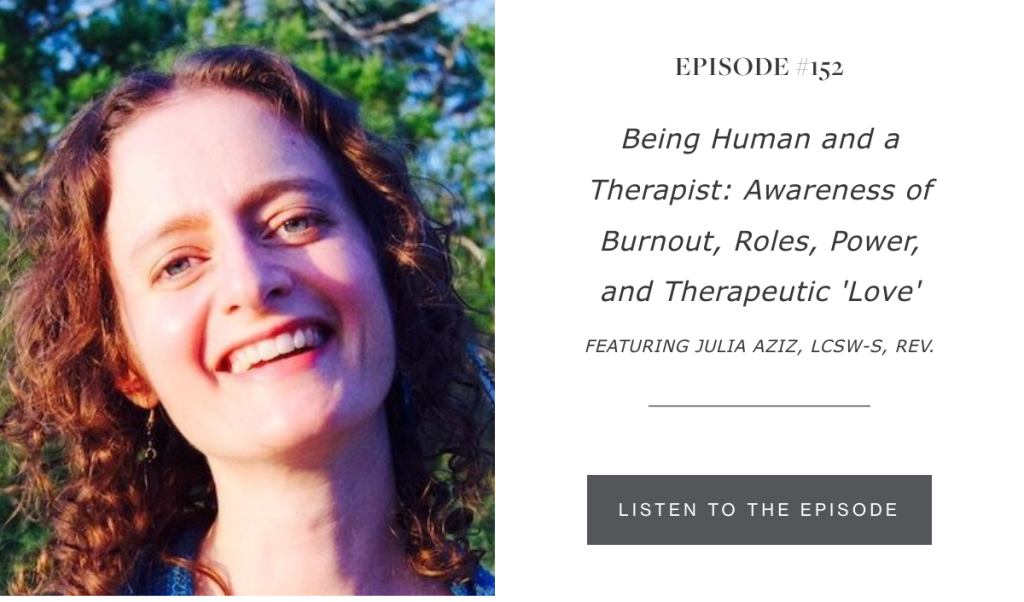
There’s a lot more nuance to discuss here, which is why I did this recent podcast interview on The Integrity Challenge of Being A Person & Being A Therapist. If you’re a helping professional of any kind or an empathic person often tending to other people’s needs, it was created for you.

Thank you for all the care you offer and for just being here and human,

Julia Aziz


***This podcast interview can be listened to for free on Spotify and all the usual podcast platforms. Mental health professionals can also earn CEU credit if they take the post-test through Clearly Clinical.***

It takes a special kind of persistence to keep showing up when we’re knocked down so often by a world falling to pieces. We need the practice of getting re-centered more than ever, and we need each other to keep us honest in it. That’s why I believe so strongly in the model of self-healing in community and the Release & Empower Women’s Group Program. Find more details on the group page, or sign up on an interest list here.

When all your “stuff” is up and you need to keep going anyway

Feel like you’re being tested? Maybe you’re backtracking in something you thought you had healed or grown from. Or perhaps you’re moving forward, but trudging through deep mud to get there. When all your “stuff” is up, and you have responsibilities you can’t just drop, well… first thing I want to say is you’re in good company. Sometimes those in helping or leadership roles feel a pressure to have it together super consistently, in pretty much all areas of life. Let’s throw that trash into the recycling bin and start with the premise that:

It’s OK to be in the middle of a process and not at the end of it.

Last fall, my daughter and I stumbled into a huge gathering of turkey vultures, but one of those birds was not like the others. A ranger later told us it was called the crested caracara, otherwise known as the Mexican eagle. This fascinating winged one looks like a hawk, flies like an eagle, and acts and eats much like a vulture. This kind of versatility is certainly called for these days.

From the Hawk

It’s good to keep a keen eye on one’s prey, focusing only on the priority of this particular moment. Tuning in acutely to what is needed here and now brings the relief of one-pointed attention. Over time, it also becomes the perseverance we need in action.

From the Eagle

Sometimes soaring above it all provides a better view. A little mental distance brings much needed perspective. We are just bitty things on this vast earth after all. The bigger pattern can’t be seen from our little corners of it. Also, let’s be real about our world context here. Is it not hubris to think we should be able to surf every rushing wave while watching others be pulled under the current? Like Krishnamurti said, “it is no measure of health to be well adjusted to a profoundly sick society.” 

Now wait, hold up! Isn’t it paradoxical, saying we need to keep a wide view and also a narrow one? Yes. I can’t think of a better time to embrace complexity, adapting as we go.

And from the Vulture

It’s important to digest the losses we’ve incurred, and find some kind of nourishment in doing so together. These losses continue to accumulate relentlessly, yet the soul food of grief is assimilated slowly, piece by piece, moment by moment. With our wingmates nearer, we may find more resources in sharing. 

I learned that the crested caracara, though a falcon, often walks on the ground and even collects material to build a nest. Bringing this all down to earth, it’s easy to spout wise words, not as easy to live them on a daily basis. This is especially true if you’re used to being the one supporting others, not needing support yourself. Yet all beings have something to offer, and all have blindspots and vulnerabilities too. If you’re faltering, please tell the truth to yourself about this, ask out loud for help, and be willing to receive it. Support may or may not come from the sources you expect it from, but a nest can be made from all sorts of material that shows up. May we make good use of what we find and create safe spaces to care for all the young, dear parts of ourselves that still need some holding. 

With love and respect for the unique creature you are,

Julia Aziz

*Sign up for my newsletter if you’d like to receive these reflections directly and also hear about upcoming offerings.

**Crested caracara image by Denis Doukhan at Pixabay