When you feel time passing quickly and can’t catch up

“How did this time go by so fast?”

This time of year always seems full of transitions. It can be disorienting, half wanting to hold on to how things have been, half feeling the need to move on. It has me contemplating one of my favorite cosmic mysteries: Time. 

I like to work with spiralinear time, the idea of time moving forward and also cycling back around again and again.

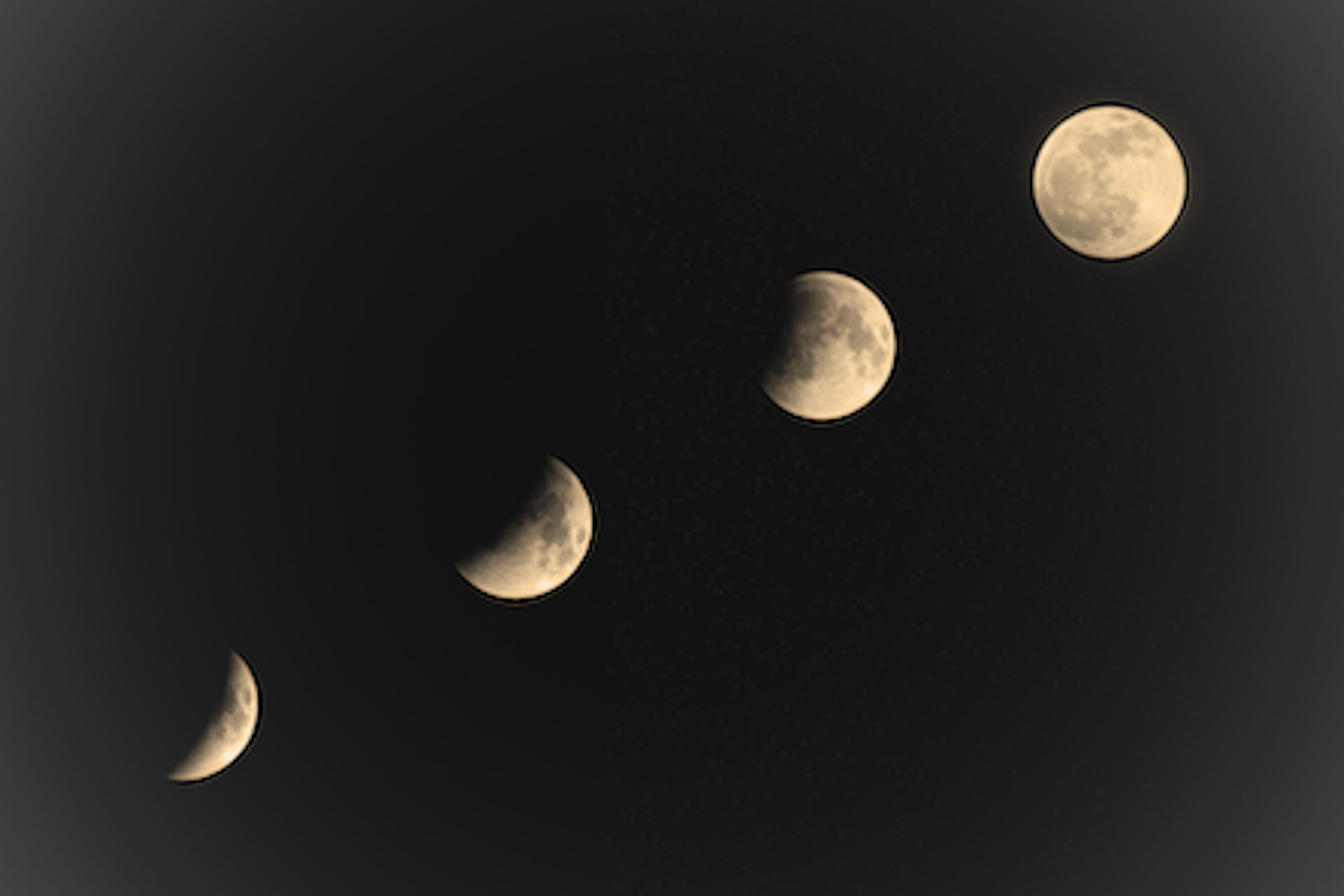
In spiralinear time, the seasons, the moon phases, the sunrises and sunsets–all are as significant as the progression of years. On the one hand, we may feel ourselves aging, children growing up, elders losing independence. Everyone moving on to new chapters, never to return to the former ones. Tuning in also to the cycles of life, we might pause in this place and moment, feeling ourselves part of a much larger pattern. Waxing and waning, expanding and contracting, giving care, receiving care. All part of a whole.

In spiralinear time, grief can walk alongside curiosity, anxiety with peace. We are, after all, inheritors of resilience. We would not be here if we weren’t. 

When I work with folks, I always start with slowing down time. We enter a longer exhale, where a minute of quiet might feel like five. It’s the best way I know to move between one thing to the next. If you are going through a transition, I hope you feel the land beneath your feet, the sky with all its glorious movements above you. In the spiral of time, we are in this together.

With love,
Julia Aziz

PS- If you do best when you’re more tuned into the cycles and taking more slow time, you might really love our women’s circle. It has a true cyclical rhythm that continues as we all grow and change 🌖
When you’re doubting yourself as a professional: a conversation on imposter syndrome

If you work in mental health, healthcare, wellness, or management, do you ever find yourself asking:

Who am I to be doing this?

How am I supposed to help others when I’m struggling myself?

Do I even know what I’m doing here? 

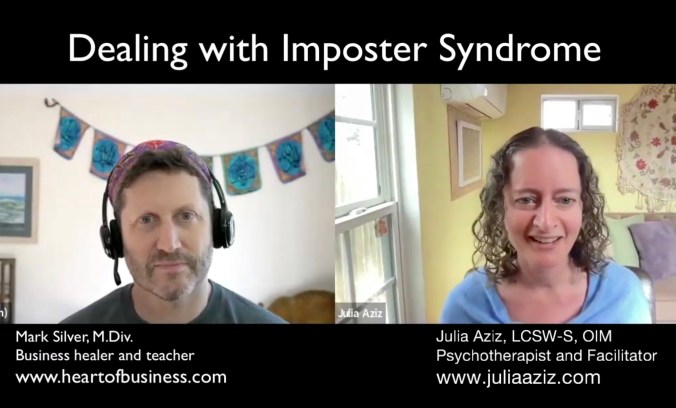
Whether you’re new to your field or well-seasoned, there will likely be times when self-doubt interferes with your deeper intention to be of service. Mark Silver from Heart of Business invited me to a conversation on these questions quite a while ago now, and I haven’t had a chance to share it with you yet! Between his business coaching with self-employed folks and the consultation and counseling work I do, we found a lot of resonance in the way we understand imposter syndrome.

If you decide to listen (just click on the image below), you’ll also receive a subscription to my newsletter. I don’t email often, only when I have a reflection or an offering to share. I know we are all bombarded with AI marketing these days, and I just want you to know how important it is to me, as a healing professional, to respect your capacity. So I only share what feels like it might help in some way. I hope this audio below brings some perspective and supports you in trusting yourself as you navigate helping others too.

Dealing with Imposter Syndrome


Thank you for all you do,

Julia Aziz

PS- If you’d like to learn a little more about my own winding path to the work I do now, check out this interview by VoyageAustin.

When it’s all too much, and self-care isn’t cutting it

Too much to respond to, too much to take care of, trying to be responsible but exhausted and worn out… What I’m hearing from many helpers and caregivers lately is “The Depletion of Too Much.”

With this particular flavor of depletion, you might even be doing lots of good self-care (or at least some, sometimes). But what we call self-care can feel like one more thing on the to-do list. Or it can help for an hour, and then it’s back to the grind. You might feel quite used up by the end of a day and not have much motivation for the next one.

Driving a couple hundred miles across the west Texas desert recently, the dusty, desolate landscape seemed to mirror this vast depletion. And yet, every once in a while, a bright blip of green would appear. Cottonwood trees, well known for their ability to survive a harsh arid climate. The cottonwood tree’s roots can spread both wide and deep to find water beneath the ground. While getting its own needs met in this way, the tree also becomes a beacon for other living beings in search of nourishment.

I wonder if we too can find a more sustainable way to both replenish and serve? 

For a human who has been doing plenty, adaptation can’t be about doing more. Seeking sustenance from where it is hidden yet abundantly available, we might instead root into the current moment experience–paradoxically receiving the relaxation, inspiration, and energy we need right here and now, in the middle of the busy.

I write these words and feel my fingers typing on the keys, while the heat of the day seeps into my skin, and the construction down the street sporadically beeps and rumbles.

Drinking in moments of being alive, no matter what those moments entail–this can be a survival skill too.

What if self-care became more self-caring? For anyone with a lot on their plate, wellness isn’t only about getting a massage or going to yoga class–though these supports are wonderful! It’s also a kindness to the struggle. A willingness to tend to the tired, rooting into what’s here and available.

Doing less, yet finding more.

May you feel your natural resilience in your very own personal way, and know how precious you are too, 

Julia Aziz

PS-If you could use some support in finding compassionate, sustainable ways to navigate life, please check out my individual, group, and community services. And sign up for my mailing list! It’s a great way to stay connected, receive a reflection like this once in a while, and learn when new groups and retreats are coming up.

When you’re anxious about the future and craving stability

Rootedness
Stability
An Anchor

These are words I’m often hearing when folks talk about what they are longing for. The question is, in this time of rapid change and uncertainty, what can be relied on?

As I was contemplating this question on a walk last week, suddenly a big hawk flew over and landed on a fence right in front of me. It checked things out for a few minutes, then looked me straight in the eye, shot out a big white poop, and flew on to a nearby tree. 

You might find this story gross, but I think it’s a pretty great response to the question!

“Release that shit and move on,” is what I hear. 

I think this process itself could be the anchor. We keep digesting, keep eliminating, and keep going.

Maybe we’re not truly designed for constancy anyway. Trees are so well-rooted, birds can fly from one to another, perching on any strong branch. Maybe we too can trust we’ll find what we need when we need it.

I think of the moon cycles too. We see the moon full for only a night or two each month, but in reality, the moon is always whole. She is a steady companion. Even though, from our vantage point, she seems to always be changing.

What I hear is nature saying:

Root in the practice of letting go and moving on.

Stabilize on what’s already here and grounded.

Find dependability in the cycles.

If you’re feeling anxious about the future and not sure how you’ll deal with the trials to come, here’s a little gift. It’s a simple song meant for the shower, the road, your community, or anytime you need a little help trusting yourself and the bigger picture: “When The Time Comes”: A Singalong for Anxious Times by Julia Aziz. It’s been good medicine for me, and I hope it will be for you too.

Wishing you a new chapter of curiosity and adaptability, with lots and lots of love,

Julia Aziz

PS- I made a choice some years ago to be consistent with certain offerings, to create a rootedness in practice and ritual. If you could use a space to rely on during these times of change, please check out the variety of offerings on this site. Or you can read these reflections in your inbox once in a while and get updates about services by signing up for my mailing list 💛

When you’re unsure and asking, “What should I do?”

As I write this, I’m watching birds nibble from the bird feeder out my window. They love when the feeder is full; they visit many times throughout the day. When the feeder is empty, they go elsewhere. Seeking direction on our own life questions, could the next steps somehow be as clear? 

Uncertainty is intrinsic to this human adventure, so asking “What should I do?” makes sense. But who gets to determine the answer? Are we meant to follow what other people do? What they say they do? What most people do? 

The problem in looking to outward authority is that no one else is living our whole story. No other person has experienced our childhood, our lineage, our hardships, and our particular gifts and blessings. There is no end to the influencers, gurus, teachers, and leaders who will speak authoritatively on how to live a life. But they too are unique and fallible human beings, no matter how wonderful, wise, or worldly.

What works for some doesn’t necessarily work for all. So what if we junk the “should” question, and wonder instead,

“What will I do?”

A question like this can feel silly, trivial, like child’s play. Maybe that’s because it points towards a subtle, innate pathway of discernment that the dominant Western paradigm has taught us to dismiss rather than claim. Play with the question when feeling in need of advice, and perhaps in time, a phrase, an image, a sensation, a flash of remembrance–some tiny pull towards what’s next might come along. 

Or maybe no response arrives. It may not be the right time to know.

Maybe instead, it’s an opportunity to shed some material things and obligations we don’t really need. 

With the extra time and space, we’ll see what happens next. Maybe follow what feels natural from there.

With more bird seed in that feeder, undoubtedly more birds will come. They go towards what nourishes them. We can remember how too.

Believing in us, and in you,

Julia Aziz

PS- Could you use some deeper support in accessing your own felt truth as you navigate challenging times? See different group and individual offerings here. And if you’re curious about this topic and related contemplations, please do sign up for my mailing list.

Image by Les Bohlen from Pixabay. I’m not quick enough to capture the birds!

When certain people drive you crazy

“Everybody is annoying once you spend enough time with them; some people are just annoying much sooner,” a dear friend declared recently. This gave us a good laugh; then we shared how we could sometimes be difficult too.

It reminds me of this summer when I took a walk on a calm ocean bay at low tide. From a distance, I could see a large rock that looked like it had a gorgeous mountain landscape painted on. Once I got close though, the moss-covered boulder that was beautiful from afar turned out to be swarmed by bugs, with a terrible smell, so rough you could barely touch it. What a metaphor for relating with people sometimes!

Certain people can be harder for us than others, of course. If you’re ever replaying a challenging interaction with someone or ruminating over issues with them that may not be resolvable, here’s a question I’ve found helpful to ask:

From what distance can I see the bigger picture–and the humanity of this person?

It’s sometimes easier to feel acceptance towards a person from further away. Sometimes we need to let the emotional space between us be like the wide open sky above the sea–vast and limitless. Other times we might need to just back up a bit and take some room to process. It’s OK to be further apart for a while and get closer later, this time with better boundaries in place. It’s also OK to not know how we’ll feel in the future and just honor the space needed right now.

Detaching isn’t always the answer, though. When struggling with someone we’re trying to stay close to, there may be a different question:

Can I get in the muck with this person and grow from the experience?

We are all messy complex beings interacting with other messy complex beings. Navigating the ebb and flow of relationship, learning what we need to learn from our own and others’ imperfections– it may not be our preferred curriculum, but it’s always available in this human incarnation!

Though some relationship decisions are black and white, most aren’t. Nuance doesn’t fit neatly into a virtual square with a pretty background, so maybe that’s why it’s so needed these days. Letting go of the search for quick and definitive answers, we may have more patience to walk with the questions–and with each other.

Wishing you trust in your own discernment and the kind of unconditional friendship with yourself that embraces all parts of you, the shadow and the light, the gross and the beautiful! And some slow time in good company, because we nourish each other too. 

With respect, compassion, and care,
Julia Aziz

PS- One of the things I love about working with people is creating clean containers to explore the messiness of life. If you could use some support with being human and dealing with other humans, please check out the rest of my website for individual, group, and community offerings. And sign up for my mailing list! It’s always a good way to stay connected.

Photo by Srozan Nadzmi on Unsplash. This photo is not of the actual rocks from my beach walk! I prefer to wander without a phone, so couldn’t capture the moment 💛

Integrating Ritual and Sacred Time in Therapy

If you’re a mental health or healthcare professional interested in ritual, ceremony, and/or the integration of a spiritual perspective into psychotherapy work, give a listen to this podcast interview/CEU course. We explore meaningful ways to honor both big and small transitions–without imposing any particular beliefs or practices. With an emphasis on discernment and cultural humility, this conversation is meant to empower and inspire clinicians, opening more creative possibility for supporting the human experience.

New Podcast CE Course Featuring Julia Aziz, LCSW-S, OIM. Rituals for Resilience: Supporting Clients Through Change Using Culturally-Attuned Ceremonies

Available on all the usual podcast platforms on Light Up the Couch.

*Find more support for professionals through individual or group consultation, the women’s group program, individual psychotherapy, and/or personal ceremony.

When you need to push through and keep going

“I’ve got a lot going on.”

“I may not like this process, but I need to push through.”

“I would love to take a break, but there’s too much to take care of.”

These sound familiar? Whether it’s a crisis, a big life change, social action, or relentless responsibilities, sometimes we need to answer the call of necessity–no matter how we’re feeling about it. The question is how to push through with vitality, rather than straining to the point of collapse.

It reminds me of a time when my seventeen-year-old sedan gave up on the hill of a highway frontage road. Cars were speeding by, blaring their horns, but there was no hope of revival. Luckily I was able to coast down to the exit, landing on the side of the road. That car had had enough. It had been pushed too far and too long, without the maintenance it needed to keep going. 

No one wants to be that old car! If we’re going to do more–for our work, for our families, for our communities–we will need to do more to sustain ourselves too. Sure, we’d all prefer a break to a breakdown. But when life is too full to take time off, we might have to take what I’ll call “time in.”

“Time in” might look like purposefully moving a little slower than our regular pace, especially during a busy day. Listening to a bird sing during a rare pause in the action, rather than checking email. It’s like the old Zen teaching on lengthening your meditation when you have less time to sit. Need to do more? Do less too.

“Time in” might also look like an intentional mini-breakdown. In a safe space, a good cry, a wild tantrum, or a full somatic anxiety release can relieve some of the tension that comes from having to keep it together. A little rest afterwards, and it can be just the right medicine for getting back up and keeping on going.

But hey, sometimes self-care can feel like just one more thing, so if that sounds like too much, it’s not necessary. The pressure to stay on top of everything is like the pressure of those passing drivers blaring their horns: it’s not going to solve the problem, it’s only going to stress us out more. Better to give up on being superhuman!

When the long road ahead is worth the trouble, we’ll each find a way through. 

I respect that there are times in life that require more of us. It can even be empowering to know we can step up when needed. Other times, it just doesn’t work to say “C’mon, get up, you can do this! What do you need to push through?” In these situations, maybe there’s a downshift, a “Here I am. Here’s my capacity. Now what will I do with it?”

Wishing you replenishing rest stops wherever you can find them, and a bit of coasting downhill too, 

Julia Aziz

PS- Need some supported time-in? Check out my individual therapy or the Release & Empower Women’s Group Program. And be sure to sign up for my mailing list; you’ll receive some free, easy ways to love yourself through all the ups and downs of life.

Image by Tobias Brunner from Pixabay

When you’re feeling worried

Do you ever feel like your concerns are repeating on an endless loop? “What if… but then, what if…?” To deal with the noise, you might be controlling everything you can, googling down rabbit holes, or seeking distraction. No matter how you cope, it’s hard to think clearly with a worried mind.

In contemplating worry, I like to remember a morning walk I took in northern California last fall. My mind was full from a recent family crisis, and ruminating thoughts were completely distracting me from the surrounding beauty. Then I noticed a small opening inside a big redwood tree. Curious, I squeezed through and found myself in complete darkness. I felt my way around the space and sat down until the noise in my head began to settle.

“Don’t rush to a solution. Sit here and rest,” counseled the tree.

So I did. 

The troubles plaguing my mind didn’t get resolved, but slowly, their urgency lessened. As my eyes adjusted to the darkness, I began to see shapes–and options I hadn’t been aware of before. When I reemerged from the tree hollow, I felt like myself again, mind and body back to earth.

Worry likes to say:

“Don’t let your guard down. The other shoe is about to drop. Figure it out now–there’s not enough time.”

Quiet says:

“Oh sweetie, you’ve found your way through chaos before. It’s OK to slow down. Wait until you can see your next step.”

Only we can decide which voice to listen to. 

What if fear was a doorway to trust? Despite its compelling nature, worry is not a protection from bad things happening nor does it help us think clearly or creatively. What helps in long-term crisis and uncertain change is caring, thoughtful humans offering of themselves in the particular ways they are called to contribute. More pressure won’t help; solid ground can.

As our long story continues, may we find refuge through the fear, re-rooting ourselves for inspired action. And in our darkest of hours, may the quiet voice of compassion be a true companion and guide.

Sending love,
Julia Aziz

Sign up for my mailing list to receive a few simple tools for self-compassion and well-being.

Orienting in uncertainty

This past summer I got to have another face-to-face encounter with a black bear. I was going down the winding mountain trail, she was going up, and we both stopped short upon meeting each other. I took a small step back to give her more space, trying not to fall off the mountainside. She quickly sussed me out, then turned and headed into the forest. I stood there watching her go, wistful and graced.

Every time I see a bear, I’m struck by the relaxed, easeful way they move. When they encounter something unexpected, they’re immediately alert and responsive. Then they go back to being relaxed again. Wouldn’t this be a powerful way to approach the uncertainty of our times? Relaxed and responsive, calm and available to act when needed. I like it!

I think about bears more often than most, but I still get the shock of “Oh! This is really happening now!” when I actually see one. Most of life is not so compelling. This kind of wake up call to aliveness is harder to come by when paying bills or brushing teeth. Though those mundane tasks may be exactly where more presence could help!

It makes me think of my dear friend Svenja, who died this past spring on the precipice of becoming an empty-nester. Sven was a master of savoring the moment, someone I could always count on to both dive deep and find humor in all things. On hospice care in her final weeks, one of the last texts she sent me said:

“I don’t feel like talking, It’s all a bunch of Hoo Ha. I just want to see stuff and taste stuff…”

It is all a bunch of Hoo Ha, isn’t it? We only get the moments we get. It’s a gift when we fully experience the small, everyday sensory experiences while they’re here. After all, this is really happening right now!

The point isn’t to be commanding “Be grateful!” at ourselves or each other in the little moments. Like Sven, who didn’t like to be too precious about things, we can take the pressure off. Savoring is not clinging–it fiercely appreciates then lets go. Savor and release. Relax and respond. Here and now, here and now.

I used to build forts in the woods with the neighbor kids when I was young. Storms would come, we would forget about these refuges for a while, then we’d go back and have to refortify. I think we’re in a time of inner fortification right now. We’re remembering what matters, replenishing the strength and courage we’ll need as our collective human story continues. My question is, what is this time of change asking of you?

Wishing you time to reflect, savor, and fortify—not just now, but any time you need to,

Julia Aziz

PS–If you’d like more support navigating these challenging times, we have spots available in the next season of Release & Empower: A Group Program for Women Moving Through Change. Or if you’d prefer individual counseling, please check out my psychotherapy page.

Sign up for my mailing list and receive a few easy-to-use tools for self-compassion