New podcast interview is up!

This podcast speaks to mental health, healthcare, and wellness professionals and is a little different from ones I’ve done before. Dr. Moss asks a lot about how I take care of myself while taking care of others. We talk about:

  • Being a helping professional in different realms and my personal approach as a therapist and ceremonialist
  • Learning to access and honor what the body and spirit needs 
  • Balancing self-compassion and self-discipline
  • The power of simple practices and simple truths

You can give it a listen here:

The Healthy Healer Podcast with special guest Julia Aziz, LCSW-S, OIM

Listen on Apple, on Spotify, or on any of your favorite podcast platforms.

There is no one-size-fits-all when it comes to living a life. Though we can learn a lot from each other, in the end, each person has a unique history and thus a unique path forward. As you hear more about my process, I hope you feel inspired to trust what’s right for you and bring in more of what supports your own balance and well-being.

With respect and care,

Julia Aziz

To hear about more interviews, articles, and resources, sign up for my newsletter here.

Changes that feel uncomfortable, inevitable, and not quite here yet

“Things feel uncomfortable, uncertain, surreal.”

“I know something is changing, but I have no idea what’s next.”

“I’m not sure what’s happening, how I feel, or why!”

I’ve been hearing these themes a lot lately. Some feel they’re at an unfamiliar crossroads; others are grappling with existential questions. In this Great Unsettling, it seems as if one phase is shifting without us knowing what the next one will be. Like driving through a fog and missing all the signposts, it’s a vulnerable time to be moving through.

What’s exhausting you could be your vehicle of transformation

If we accept the truth of what’s happening now, we can “offer up” our weariness, confusion, and existential uncertainty. Offering means we let what is hard for us become sacred. We acknowledge that the road ahead runs precisely through the territory we like to avoid, and we take that road in the spirit of soul growth, with courage. Surrendering some resistance, we may feel more open to receive from unexpected directions.

Changing the questions we’re asking

When we can say “I don’t know” honestly, with open curiosity, “What’s the point?” may no longer be such a heavy question. There’s something about admitting lack of control that frees up the mind to see things differently. We come back to what’s in front of us right here. Rather than “What do I do?” we might ask, “What do I do next?”

Remembering where to find the inner compass

I’ve never been one for roller coasters or winding mountain roads. I feel that instability deep in my core, right away! Maybe you’ve got the stomach for turbulence, though you still may not feel thrilled by the ride of personal and collective change. It helps to know if there’s a voice inside saying “Aghhhhhhh!!!”, there’s also one that’s good at handling things. It’s the part of us that shows up for other people when they need it. That competent, fierce, adaptable part has a better sense of direction than the tired and frightened inner child. In this new terrain, we might intentionally ask the inner adult to take the wheel.

New rules to the game? 

There’s not just one insight that changes everything, and then we’re good to go forever more. So much spiritual seeking seems to have this flavor of “if I just change in this one way, I’ll be golden, and then I can finally coast.” Who came up with this silliness? Everything alive on this earth is in some cyclical process. Life is temporary; the mystery of life is always. 

Upwards Spiral image

If you’re struggling to find your way, I hope you reach out and ask for some help. We’re really not meant to be doing all this life stuff alone. When there’s too much constriction to let in support, clearing some things out can make all the difference. Change, of course, requires some creativity–and undoing.

Wherever we go, I’m glad to be on this wild ride with you,

Julia Aziz

PS- Here’s a little off-the-cuff, less than two minute audio to support you in these strange times: Get the “Rapid Reset for Instability” practice audio.

Reviving Into A New Year

The other day, I was sitting outside with a cup of tea when a butterfly came for a visit. She fluttered around, then perched on the side of my cup, closer and closer to the edge, until she fell in. It took a few moments for me to find a twig and rescue her, lifting her drenched and struggling little body onto the rock next to me. I tried to use my breath to dry her off, but she was barely moving. I watched as she brought her little antennae to press lightly and repeatedly on her chest, almost as if she was giving herself CPR. For a long time, she just laid there still, and I figured that was the end. I went for a walk, thinking maybe I’d bury her later to honor what I had witnessed. After a half hour or so, I came back, and there she was–upright on the rock now, starting to flutter her wings a little bit. Surprised, I watched her for a while more, then took a break. By the time I came back, she had flown away. 

Revive. This word feels like it’s been taken by fundamentalists, but let’s think about it. To Bring Life Back. Wow! Nature is amazing. We have the capacity to return to life. Our metaphorical revivals are not always met with a lot of fanfare. They are often quiet, slow moving, and subtle. Nevertheless, they are real, and they are necessary.

As we enter this new year, I wonder, where have you been living a half-life, and what revival may be underway for you? This is an individual and a collective contemplation. It’s easy to see all the problems; so much in our lives and our world is not working. To be able to see differently is a big deal–maybe even essential for a new way to emerge. In 2024, my wish for all of us is to return to life with new vitality and vision, especially in the areas that need it most. 

What is the strategy here? The old way of pushing an agenda and trying to make things happen no matter the fallout has caused plenty of suffering already. What if instead we (1) take the risk of following curiosity, even if it means falling in the cup of tea (2) claim the heart’s longing to feel and revive and (3) receive the patience and support we need. Then rather than “making” transformation happen, we “let” it happen. Big vision, tiny changes. Everything grows, or returns to life, one day at a time.

Many many blessings upon you and your loved ones, and all beings of this earth, in this new year,

Julia Aziz

PS- If you could use more support in envisioning and allowing change, check out the Release & Empower Women’s Circle or my 1-1 psychospiritual counseling or consultation services. And if you’d like to receive occasional articles on self-healing and empowerment in your inbox, just sign up for the mailing list here.

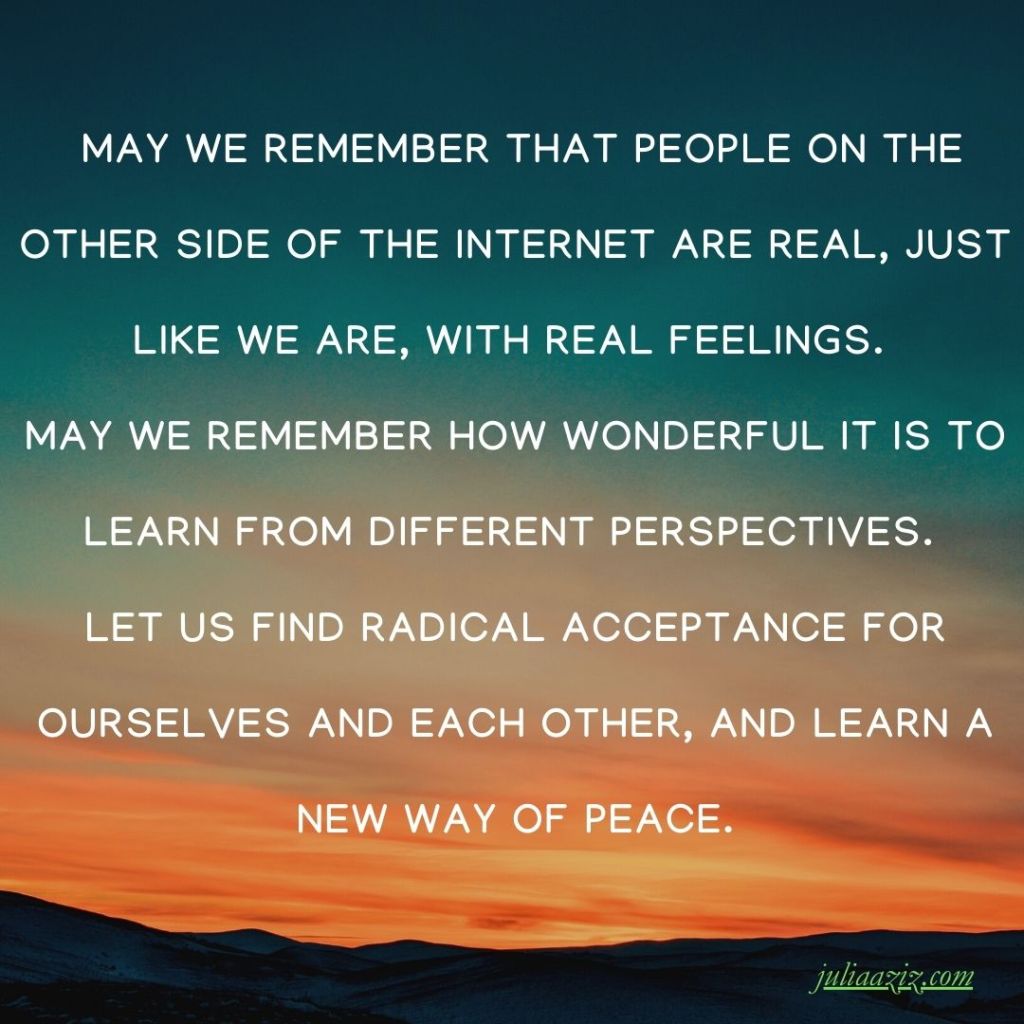
May we remember that people on the other side of the internet are real, just like we are, with real feelings. May we remember how wonderful it is to learn from different perspectives. Let us find radical acceptance for ourselves and each other, and learn a new way of peace.

On getting triggered: Anger, guilt, blame, and the feelings we don’t want to feel

I’m curious, who showed you how to feel and process anger in a healthy way?

(Just kidding, that’s not a fair question!)

Depending on our background, we may have learned to numb or suppress negative emotions, beat ourselves up, or lash out, but it’s pretty rare for an adult reading this today to have grown up in an environment that modeled well how to work with feelings like anger, guilt, shame, or fear. It’s something we as a species are still learning. We continue to trigger negative emotions in each other all the time though–that’s just being human and living in society with other humans. Part of growing into adulthood is learning how to respect what we feel while also respecting other people’s experience, and while that may sound extremely basic, it’s often extremely missing.

You may have heard the term “shadow work” before, and it may mean something different to you than it does to me. For simplicity’s sake, I’ll define it here as finding a way to work with the thoughts, feelings, and parts of ourselves we’d prefer to banish to the basement of our consciousness. Let’s say you read, hear, or see something that gets your ire up. You begin to look for fault, but rather than inwardly or outwardly blaming (or avoiding), you pause. You say to yourself, “Hey, let’s not focus on who’s wrong right now. I’m more curious about what’s happening inside you?” Maybe you notice a little voice that’s feeling scared or lost, along with some tension in the body. And you don’t try to do anything; you just be kind about it. You offer empathy and compassion to yourself the way you would if a dear friend was sharing something similar. Giving attention to thoughts, feelings, and sensations with care in the heart, you may find yourself breathing more deeply and noticing more nuance. Maybe there is something to say or do now or maybe not. At some point, you’ll know what the next step is for you.

This is just one of many different ways we can work with triggers. Shadow work helps us to be less controlled by our conditioning and inner demons, so we can return to our truest essence. The big triggers need big patience and support. And if we’re often holding space for other people’s triggered feelings, making room for our own is doubly important.

Anger is part of a guidance system–it points us toward boundaries that need setting and power that needs rebalancing. Once we’ve moved through its fire, we can use it as fuel for change. Rather than asking who is to blame or getting stuck ruminating over what other people are doing, we might look at questions such as: How can I accept my whole self, with all my feelings and history, and take courageous action from a place of centered clarity? What is my unique role here to play in the bigger context? As social beings, we have the power to regulate and disregulate each other. In tending to ourselves and showing up again to the complexities of living in society, we make a difference. 

The quieter voices in the room, just like the quieter voices in ourselves, have some important things to say. Listening and learning, we evolve together.

In the school of life with you, in gratitude for our connection,

Julia Aziz

Sign up for my mailing list to receive reflections like this in your inbox.

PS-If you need at-home support with the kind of shadow work we’re talking about, try the simple practice outlined in this little book. It’s an affordable, accessible resource for anyone feeling challenged by negative emotions and looking for a new way.

PPS-Here’s a song by the Middle East Peace Orchestra for more support to feel.

We each have our own role to play in the emergence of a new way. May those who are struggling for their lives, traumatized, and grieving be protected, supported, and loved. May the wisdom and power of our hearts prevail.

When you give your attention to everyone else first

Do you ever feel upset at people for asking too much, but you keep those feelings to yourself and do what they ask anyway?

Do you procrastinate what’s important to you while continuing to meet others’ expectations?

Do you sometimes feel unseen and taken for granted?

Maybe when you were young, you felt all the feelings in a room, and you took on the responsibility of making everyone else feel comfortable. Maybe you found security in caretaking those whose needs seemed to loom larger than your own. Now mind you, these aren’t bad tendencies; our society as a whole sure could use more sensitivity and caring about each others’ feelings! But when caring becomes people pleasing, it gets out of balance, becomes inauthentic, and can result in major burnout when one person is doing all the accommodating. So how do we unlearn the old patterns while holding onto our hearts?

In my experience, people who were conditioned to center their orbit around others often need more permission to value themselves. I’m actually not talking about putting on your own oxygen mask first or any other “me first”. “Me first” can get just as unbalanced as the “you first” culture of helpers and caregivers. You don’t have to stop caring for others; you can include yourself amongst the people you care for. If we become part of the “us,” it’s not about my needs vs. your needs. It’s about expanding the heart space for all. 

Like trees in the forest, we grow best as humans in community. Together, we re-discover our resilience and the healer within who knows just what to do.

Grateful to be in connection with you,

Julia Aziz

*The challenge of shifting from “you” to “us” is that past conditioning can have quite a stronghold, especially when old triggers persist and new patterns aren’t yet firmly rooted. That’s why making changes alongside other people is so effective. Just like you might go to a fitness class if you were trying to get in better shape physically, if you’re unlearning people pleasing, perfectionism, overdoing, and other accommodating patterns that lead to burnout, a group program like the Release & Empower Women’s Circle can support a real shift. More details on our next season can be found here.

Sign up for my mailing list if you’d like to explore similar topics together in the future.

Image by Rosy from Pixabay

New Podcast Interview on Self-Healing, Spirituality, and Therapy

“I just gave and gave and gave. And now you’re telling me I’m the one inside, I have to heal myself?!?”

If you spend time helping or caring for other people, you may resonate with this question Sindee posed to me in our recent conversation about self-healing. It’s a valid point! How do we show up for others as well as ourselves when we’re depleted or going through our own struggles? I hope you give this interview a listen. I so enjoyed discussing shifting perspective in how we approach service and the importance of nourishing our own spiritual lives. 

Though this interview is part of a therapist podcast, its underlying message is truly for any individual who is often supporting others. I hope you know how much you matter–not just because of what you are to other people, but because you exist here too! 

With love,
Julia Aziz

Sign up for my mailing list and receive more free content of this ilk 🙂

When you’re unwell and people still need things

Have you struggled to tend to the needs of patients, children, clients, or elders while you were going through your own big or small health crisis? I share these inquiries with you today in honor of all the caregivers contending with illness or pain, whether there’s cancer, autoimmune disease, recovery from an acute health emergency, long or short covid, or the many other viruses and bacteria we experience living in a body.

Listening in

Our bodies are always talking to us, and those of us with particularly sensitive nervous systems are privy to a whole lot of conversation. Listening to the body, like learning any new language, requires some persistence and patience. One message that’s often loud and clear though is “slow down and rest”. Sometimes the rest we need is much deeper than a temporary pause, and it questions the very pacing and choices of our lives. We might ask, “What is this illness slowing me down from, and what is it asking me to change?” We may not like the answers to these questions, but we can still tell the truth to ourselves and take some time before choosing what to do about it. 

My new favorite word: Divest

Some humans could use a little more empathy, but many kind caregivers are actually learning to divest. Divest from caring quite so much, divest from being so acutely tuned in to other people, divest from the stories we tell ourselves about how we’re not doing enough. And let’s not forget divesting from standards that are too high to maintain when we’re ill. In divesting, we might ask, “What can I not do? What can be postponed? What could someone else do?”

Asking the now 

Have you ever gotten overwhelmed by the multitude of supplements you should be taking, practices and exercises you should be doing, and all the doctors and healers you should make appointments with? That overwhelm matters for your well-being too. Taking a slow breath, we remember that the body asks for what it needs in the now-time. Can responding to that one need be enough, just for this moment? What would it feel like to trust in taking one step at a time?

Compassion is not complete if it doesn’t include you

Being sick can make us cranky, fearful, zoned out, and despairing. It’s ok to be angry; it’s ok to grieve. Sometimes rather than a pep talk, we just need someone to say, “Sweetie, that totally sucks. It’s so hard. I love you.” That someone might need to be you–whether or not you’re near people who care. No one is going to know just what you’re going through like you do, and the voice of your caring heart needs more airtime than any inner critic. 

Illness making you matter

If you’ve been centering your life around other people and giving less to your own body and spirit than you do for everyone else, illness may be asking, “What about you?” We can’t just keep grasping at crumbs and expect that to be sustenance for caregiving. It’s OK to be high maintenance, to need a lot of emotional and physical self-care in order to continue to be of service to others. It’s also OK to dream your own dreams sometimes. You exist here too, and if there’s one person you are most responsible for, it’s you. 

Wishing you gentle loving kindness, tons of patience, outrageously vibrant health, and a whole lot of letting yourself off the hook.

Warmly,
Julia Aziz

Sign up for my newsletter to receive occasional reflections in your inbox.

More encouragement for rest:
Rest is Resistance book by Tricia Hersey
Podcast interview on Time Management for Mortals
Beautiful Chorus song we’ll be resting or moving to in the women’s circles this week

On offering and receiving healing work online

I’m the last person I would have ever imagined working online. A cabin in the woods without WiFi is my favorite weekend getaway, and when I learned about Luddites during a semester abroad in England, I was instantly enamored with the idea of smashing computers–and that was before the internet! Yet here we are a few years into our crazy new world, and I’m still discovering unexpected blessings in healing work online.

What I’m Appreciating

For people who are self-conscious about being seen moving their bodies, making noise, crying, or otherwise releasing deep emotions, a well-tended online space is a chance to really let loose–in privacy yet supported.

For people who keep their cards close to their chest, meeting online can feel both safe and liberating, inviting a “why not?” kind of courage to take bigger risks in speaking what’s true.

For people who struggle with the self-discipline of regular practice and thrive with the accountability of a group, meeting online supports healthy routine. It requires one to remove distractions and set up their space well, building the foundation for regular self-healing practice where it’s most needed–at home and in everyday life.

For empaths and highly sensitive people who are often overly tuned in to others, being online offers the opportunity to build mastery in staying grounded and present in the body while connecting to another person.

For people who have been failed by experts and gurus, or people who have long been searching for answers outside themselves, online healing work can be ideal for practical and energetic reasons. Practicing self-healing tools with online support can give power back to the person in the “receiving” role, encouraging self-worth and sovereignty. 

For people with a lot of responsibilities–you’re busy, it’s convenient, I don’t think I need to say more!

On Being Together In Person

Meeting online will never replace being with people physically. That’s just silly (and scary)! My current approach has been to learn and participate in online spaces, then show up open and available when I see loved ones or meet new folks in person. Personally, I find I have a lot more appreciation and bandwidth for both healing experiences and social connection when I’m not out there all the time. 

As for my own offerings, I am loving working with both individuals and groups online, providing protected space for deep release and renewal. I am also continuing to offer in-person ritual, ceremony, workshops, and retreats, as we need that special time to be together, on the earth, face to face.

On Release & Empower

If you’ve been feeling drained by too many Zoom calls, but you’ve been toying with the idea of joining a women’s circle this season, here are a few things to know: 

We spend most of our time together not engaging with the screen. We do expressive writing, move our bodies to music, relax and receive, and then only at the end do we sit together for sharing and witnessing. Note: we don’t stay in front of the screens during the music, so you can feel free and private experimenting with movement.

You can skip weeks whenever you need to (and it’s OK to come late). We all need a break sometimes.

More opportunities for connecting with women in the group are available. If you’ve been in a group before, you know just how amazing the women are. An in-person intensive created especially for current and former circle participants happens in the spring in Austin. You can learn about the Spring Intensive here. And you’ll hear about other workshops and in-person opportunities as they arise by just signing up on my mailing list.

Thank you for reading and continuing to connect in the different forms available to us. I trust you know where you’re at and what you need, and I’m wishing you just the right support, in right timing.

Julia Aziz

Learn more about the online circle: Release & Empower: A Group Program for Women Moving Through Change

When you’re getting weary and burning out

A few weeks ago, I presented a continuing education workshop for mental health professionals on burnout and compassion fatigue. I didn’t share it with y’all because those particular words feel so stale and overused these days. What are we really talking about here?

  • Feeling inwardly irritable or cranky towards clients, children, elderly parents, or other people you serve, though you keep showing up for them
  • Getting scattered and flitting from thought to thought as you respond to multiple demands
  • Intellectually knowing you care about people or issues but not *feeling* that care in your body
  • Trying to do too much and feeling drained and tired hours before it’s time to sleep
  • Being unable to do much beyond what is expected, with every day feeling like more of the same
  • Ruminating on other people’s trauma and trying to fix things out of your control
  • Frequent contemplation of changing careers or what life would be like without your current caregiving role(s)

If you’ve experienced one or more of these symptoms, it doesn’t mean you’re a bad person or an impostor. You’re a person who is trying to meet a lot of outer expectations and doing the best you can. The balance of what’s coming in and out just isn’t working. 

Moving from burnout to reigniting the flame within

I often think of burnout as the passionate and loving heart burning down to a low flame, maybe even just the hot coals, with no one feeding or tending the fire. If it extinguishes itself, you’re left out in the cold. If the right wind blows, you might flare up again, but the heat and energy will likely be scattered, maybe even perilous with no one there to support or contain it.

To find enthusiasm for life and the service we do, we must tend the inner fires of compassion and inspiration. But what does that mean?

Here’s my three cents: 

(1) Regularly clearing out what doesn’t burn to make more space for the good wood. In addition to good “emotional hygiene”, this means paying honest attention to what is wearing you out and being willing to make courageous choices about what you give and don’t give your precious life energy towards.

(2) Creating a good container to protect the fire. No one else is going to track what you’re doing all day long and insist you prioritize your own needs in real, tangible ways. Only you can carve out and protect the space you need.

(3) Feeding the fire with new experiences, authentic expression of what you really feel, and creativity that nourishes the inner wild one. When you feel like you’ve lost your mojo, it may be time to mix things up.

Gathering around the collective fire

Changes like this can be hard work, especially when you’re already weary! Sometimes the burnout has gone on too long and to truly warm up and burn bright again, we first need deep quiet and rest. Then it’s time to rebuild with some dedicated time, support, and a much bigger blaze. That’s why I’m so passionate about community healing work (and what the Release & Empower Women’s Circle* is all about). When individually, you have only a little light left to share, you can offer it up to a larger fire. In surrendering over and over again, you may find yourself slowly rising from the ashes, finding passion and compassion bit by bit, energized by the fuel of being amongst fellow humans doing the same.

I hope one way or another, you always find a little light nearby and know there is one within you too. You are doing good work out there! May all that you give come back to you tenfold, even in unexpected ways.

With kindness,

Julia Aziz

*In the past few years of facilitating the Release & Empower Women’s Circle, I’ve witnessed women making brave changes in their work, relationships, health, and lives, not to mention those inner changes in freedom, confidence, and authenticity. These changes are theirs to claim, not mine. This is just what happens when women come together to re-ignite their inner fire. Check out the group page for more details and to sign up for our next season.

**If you’d like to receive more reflections like this once in a while, just sign up for my mailing list.

Image by Leandro De Carvalho from Pixabay 

When you’re trying to let go

I’m happy to say I’ve been meeting new friends on my morning walks again. Just last month, I had encounters with a porcupine, owls, armadillos, hawks, foxes, a crested caracara, and coyote. I always try to play it cool, gently slowing down without making too big a deal of it, wanting to greet the animals in a natural way. As you might imagine, they don’t often hang out for more than a few moments, and I find myself feeling wistful each time they leave. Not knowing when or if we might meet again, I’m left with a fleeting joy, better nourished by the connection.

If you’ve been involved in spiritual, self-help, or personal growth circles, you’ve been hearing the phrase “let go” anywhere you look and listen. Lately, I’ve been curious about what I’m calling “letting leave,” a concept best taught by our wise companions and caregivers, the trees, in this new fall season. Letting leave is a less active, more receptive process than letting go, one that honors a timeline beyond human will. The leaves of a tree are not hustling and on the go; rather, when their time comes, they simply fall to the earth. A gust of wind or a big storm may also blow through and accelerate the process of leaving. Life is like this too, isn’t it? Smooth or sudden, ready or not, when change wants to happen, it will. 

In the healing arts, we often begin with what we want to let go of. What’s wrong, what’s the presenting concern, what are you struggling with? A problem focus is helpful in knowing what needs attention, but concentrating too much on the issue can sometimes hinder its release. As I see it, one of the key aspects to actually receiving help and letting support in is being able to let suffering leave. On the surface, we all want that. But when you’ve been struggling with something for a long time, be it physical, emotional, mental or spiritual, the question of “Who am I if I’m not a person with this pain?” feels almost incomprehensible. There’s no easy bypass here; instead, we might keep asking the question. At a deep level of consciousness, we “let leave” the attachment to knowing what we are or how change will occur.


The letting leave process doesn’t often happen in one fell swoop; everything has its season, and seasons come and go too. It can become a bit easier to trust the natural cycles when we notice the subtle shifts happening all the time. Have you ever found yourself telling a familiar painful story, and realized it’s not actually true or still happening in this moment? Healing may be the recurrent “in the now” experience of letting the resistance to what’s hard leave. It is also, as the Buddhists know well, the loosening of our clinging to what feels good. I watch those trees rooted down into the soil, and see how they allow more powerful forces to weather and therefore strengthen them. We have this capacity too, when we are grounded and willing to hold lightly what we think we have to do.

The invitation I’m hearing this fall is to soften and find courage in letting what needs to go leave when it’s ready, whether that’s old patterns, beliefs, or something more tangible. There will be grief, and sudden loss especially will need plenty of time and love to integrate. In holding sacred the leaving times, may we also find deep appreciation for all that is here with us now.

Until next time, thank you for reading,

Julia Aziz

Click here to receive musings in your inbox every now and then

I was able to catch a photo of this cutie pie, thought you might appreciate 🙂