On helping others through troubled times that affect you too

There’s a question I’m hearing a lot, and it’s not a new one. If you’ve been emotionally supporting other people in some way, this question has been relentless in recent years:

How am I supposed to help people through a collective crisis that I am dealing with myself?

As a therapist, group facilitator, and mother of three, I know many parents, mental health practitioners, healthcare and wellness providers, caregivers, teachers, and managers who are processing double-time. I’m not going to try to answer this question; there’s already plenty of advice coming at you. These are just some thoughts for contemplation.

  • It is not our job to know better, be better, draw a silver lining around a dark cloud, or fix things just because we are in some sort of helping or leadership role. Like everyone else alive today, we’ve also never lived through this particular time in history. Lessening the pressure we put on ourselves gives room to breathe–and think more clearly.
  • It is absolutely our job to truly tend to our ourselves so we can maintain the capacity to show up for others. That may look like receiving more support, but it’s not only about care from the outside. It’s also things like how kindly we talk to ourselves. How we say no and rest. How we let our bodies express the fear or dread or rage or grief, so we don’t have to suppress or project feelings in order to keep going. 
  • Showing up with an open, listening heart in deep curiosity about the individual experience of the people we are serving matters. Collective crises do not affect all of us in the same way. Holding a space open for someone (or a group of someones) to work through their own unique experience is a real service. Especially in a time when their other loved ones may not be emotionally available.

I know many kind caregivers feeling like they have to pretend to have hope or optimism when the truth is, they are feeling the dark night. Could it be okay to orient towards “being with” rather than “doing for” others right now? I look to the trees, the river, the animals, the moon, the ancestors. I know even when we don’t want to be where we are in the cycle, we are here. 

If you need a break from people, I hope you can take one. If that’s not possible, I hope you find a refuge for your own feelings, and know that whatever you can give is enough.

With care and courage,

Julia Aziz

SUPPORTS FOR THE HELPERS

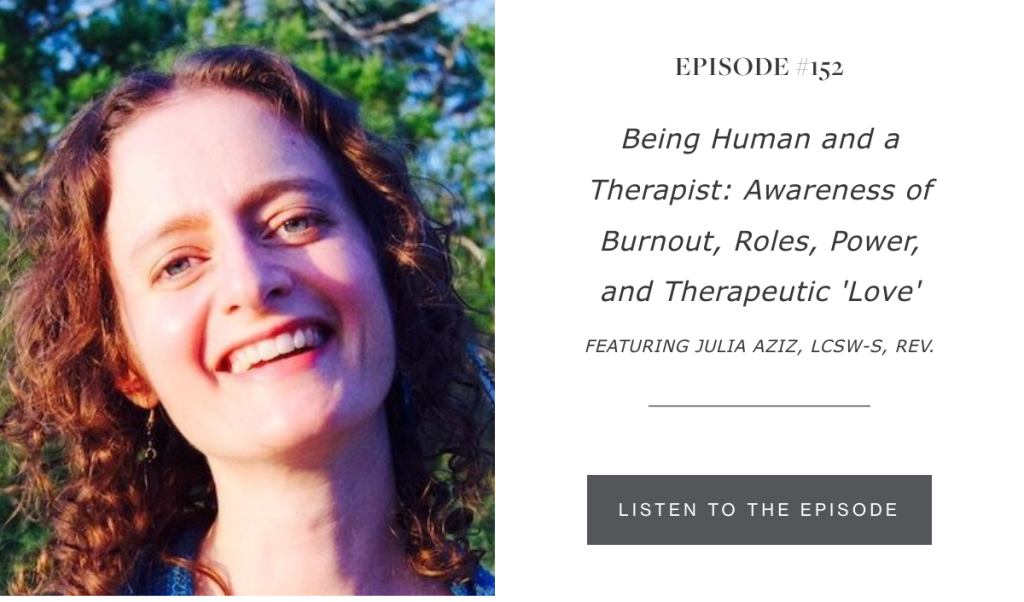
–A reminder about this Clearly Clinical podcast interview for professionals struggling with their own heavy times while still helping others

–If you could use a place to be yourself amongst other helpers, and you identify as a woman, save a spot in the next season of Release & Empower: A Group Program for Women Moving Through Change. In troubled times, it feels like such a nourishing, fortifying gift to be with women feeling, releasing, and re-centering side-by-side in nonverbal and expressive ways.

–If you’re a mental health professional wanting more clinical and professional development support, you can set up an individual consultation session or join my consultation group.

Sign up for my mailing list and some simple self-support practices here.

Reviving Into A New Year

The other day, I was sitting outside with a cup of tea when a butterfly came for a visit. She fluttered around, then perched on the side of my cup, closer and closer to the edge, until she fell in. It took a few moments for me to find a twig and rescue her, lifting her drenched and struggling little body onto the rock next to me. I tried to use my breath to dry her off, but she was barely moving. I watched as she brought her little antennae to press lightly and repeatedly on her chest, almost as if she was giving herself CPR. For a long time, she just laid there still, and I figured that was the end. I went for a walk, thinking maybe I’d bury her later to honor what I had witnessed. After a half hour or so, I came back, and there she was–upright on the rock now, starting to flutter her wings a little bit. Surprised, I watched her for a while more, then took a break. By the time I came back, she had flown away. 

Revive. This word feels like it’s been taken by fundamentalists, but let’s think about it. To Bring Life Back. Wow! Nature is amazing. We have the capacity to return to life. Our metaphorical revivals are not always met with a lot of fanfare. They are often quiet, slow moving, and subtle. Nevertheless, they are real, and they are necessary.

As we enter this new year, I wonder, where have you been living a half-life, and what revival may be underway for you? This is an individual and a collective contemplation. It’s easy to see all the problems; so much in our lives and our world is not working. To be able to see differently is a big deal–maybe even essential for a new way to emerge. In 2024, my wish for all of us is to return to life with new vitality and vision, especially in the areas that need it most. 

What is the strategy here? The old way of pushing an agenda and trying to make things happen no matter the fallout has caused plenty of suffering already. What if instead we (1) take the risk of following curiosity, even if it means falling in the cup of tea (2) claim the heart’s longing to feel and revive and (3) receive the patience and support we need. Then rather than “making” transformation happen, we “let” it happen. Big vision, tiny changes. Everything grows, or returns to life, one day at a time.

Many many blessings upon you and your loved ones, and all beings of this earth, in this new year,

Julia Aziz

PS- If you could use more support in envisioning and allowing change, check out the Release & Empower Women’s Circle or my 1-1 psychospiritual counseling or consultation services. And if you’d like to receive occasional articles on self-healing and empowerment in your inbox, just sign up for the mailing list here.

May we remember that people on the other side of the internet are real, just like we are, with real feelings. May we remember how wonderful it is to learn from different perspectives. Let us find radical acceptance for ourselves and each other, and learn a new way of peace.

When you give your attention to everyone else first

Do you ever feel upset at people for asking too much, but you keep those feelings to yourself and do what they ask anyway?

Do you procrastinate what’s important to you while continuing to meet others’ expectations?

Do you sometimes feel unseen and taken for granted?

Maybe when you were young, you felt all the feelings in a room, and you took on the responsibility of making everyone else feel comfortable. Maybe you found security in caretaking those whose needs seemed to loom larger than your own. Now mind you, these aren’t bad tendencies; our society as a whole sure could use more sensitivity and caring about each others’ feelings! But when caring becomes people pleasing, it gets out of balance, becomes inauthentic, and can result in major burnout when one person is doing all the accommodating. So how do we unlearn the old patterns while holding onto our hearts?

In my experience, people who were conditioned to center their orbit around others often need more permission to value themselves. I’m actually not talking about putting on your own oxygen mask first or any other “me first”. “Me first” can get just as unbalanced as the “you first” culture of helpers and caregivers. You don’t have to stop caring for others; you can include yourself amongst the people you care for. If we become part of the “us,” it’s not about my needs vs. your needs. It’s about expanding the heart space for all. 

Like trees in the forest, we grow best as humans in community. Together, we re-discover our resilience and the healer within who knows just what to do.

Grateful to be in connection with you,

Julia Aziz

*The challenge of shifting from “you” to “us” is that past conditioning can have quite a stronghold, especially when old triggers persist and new patterns aren’t yet firmly rooted. That’s why making changes alongside other people is so effective. Just like you might go to a fitness class if you were trying to get in better shape physically, if you’re unlearning people pleasing, perfectionism, overdoing, and other accommodating patterns that lead to burnout, a group program like the Release & Empower Women’s Circle can support a real shift. More details on our next season can be found here.

Sign up for my mailing list if you’d like to explore similar topics together in the future.

Image by Rosy from Pixabay

New Podcast Interview on Self-Healing, Spirituality, and Therapy

“I just gave and gave and gave. And now you’re telling me I’m the one inside, I have to heal myself?!?”

If you spend time helping or caring for other people, you may resonate with this question Sindee posed to me in our recent conversation about self-healing. It’s a valid point! How do we show up for others as well as ourselves when we’re depleted or going through our own struggles? I hope you give this interview a listen. I so enjoyed discussing shifting perspective in how we approach service and the importance of nourishing our own spiritual lives. 

Though this interview is part of a therapist podcast, its underlying message is truly for any individual who is often supporting others. I hope you know how much you matter–not just because of what you are to other people, but because you exist here too! 

With love,
Julia Aziz

Sign up for my mailing list and receive more free content of this ilk 🙂

When you’re getting weary and burning out

A few weeks ago, I presented a continuing education workshop for mental health professionals on burnout and compassion fatigue. I didn’t share it with y’all because those particular words feel so stale and overused these days. What are we really talking about here?

  • Feeling inwardly irritable or cranky towards clients, children, elderly parents, or other people you serve, though you keep showing up for them
  • Getting scattered and flitting from thought to thought as you respond to multiple demands
  • Intellectually knowing you care about people or issues but not *feeling* that care in your body
  • Trying to do too much and feeling drained and tired hours before it’s time to sleep
  • Being unable to do much beyond what is expected, with every day feeling like more of the same
  • Ruminating on other people’s trauma and trying to fix things out of your control
  • Frequent contemplation of changing careers or what life would be like without your current caregiving role(s)

If you’ve experienced one or more of these symptoms, it doesn’t mean you’re a bad person or an impostor. You’re a person who is trying to meet a lot of outer expectations and doing the best you can. The balance of what’s coming in and out just isn’t working. 

Moving from burnout to reigniting the flame within

I often think of burnout as the passionate and loving heart burning down to a low flame, maybe even just the hot coals, with no one feeding or tending the fire. If it extinguishes itself, you’re left out in the cold. If the right wind blows, you might flare up again, but the heat and energy will likely be scattered, maybe even perilous with no one there to support or contain it.

To find enthusiasm for life and the service we do, we must tend the inner fires of compassion and inspiration. But what does that mean?

Here’s my three cents: 

(1) Regularly clearing out what doesn’t burn to make more space for the good wood. In addition to good “emotional hygiene”, this means paying honest attention to what is wearing you out and being willing to make courageous choices about what you give and don’t give your precious life energy towards.

(2) Creating a good container to protect the fire. No one else is going to track what you’re doing all day long and insist you prioritize your own needs in real, tangible ways. Only you can carve out and protect the space you need.

(3) Feeding the fire with new experiences, authentic expression of what you really feel, and creativity that nourishes the inner wild one. When you feel like you’ve lost your mojo, it may be time to mix things up.

Gathering around the collective fire

Changes like this can be hard work, especially when you’re already weary! Sometimes the burnout has gone on too long and to truly warm up and burn bright again, we first need deep quiet and rest. Then it’s time to rebuild with some dedicated time, support, and a much bigger blaze. That’s why I’m so passionate about community healing work (and what the Release & Empower Women’s Circle* is all about). When individually, you have only a little light left to share, you can offer it up to a larger fire. In surrendering over and over again, you may find yourself slowly rising from the ashes, finding passion and compassion bit by bit, energized by the fuel of being amongst fellow humans doing the same.

I hope one way or another, you always find a little light nearby and know there is one within you too. You are doing good work out there! May all that you give come back to you tenfold, even in unexpected ways.

With kindness,

Julia Aziz

*In the past few years of facilitating the Release & Empower Women’s Circle, I’ve witnessed women making brave changes in their work, relationships, health, and lives, not to mention those inner changes in freedom, confidence, and authenticity. These changes are theirs to claim, not mine. This is just what happens when women come together to re-ignite their inner fire. Check out the group page for more details and to sign up for our next season.

**If you’d like to receive more reflections like this once in a while, just sign up for my mailing list.

Image by Leandro De Carvalho from Pixabay 

Podcast Interview for Therapists and Other Helping Professionals

How are you supposed to help other people when you’re struggling yourself? 

I hear this question all the time in my work with helping professionals and moms. You’re not immune to personal and collective stress, yet somehow you need to keep showing up with a clear mind and full heart for the people you serve. You may have days when you feel overwhelmed by the world, unsure about everything, and barely making it through, but you can’t just phone it in. So when you have a big life stressor or three to deal with, what’s a caring person to do? 

Well, let’s first look at the assumptions we’re starting with in asking this question. Many individuals in helping roles learned early on that their value depended on what they could do for other people. When a sense of self-worth gets attached to other people’s needs, a belief begins to develop that may remain subconscious for years, namely: “Other people can struggle, but I’m supposed to be strong.” I call this the hidden ego of helpers, this idea that we somehow should be Zen masters in all areas of life and above the pain and suffering that affects everyone else.

It’s a nice thought, aside from being an impossible ideal not fit for a complex and genuine human being. So let’s chuck that one in the recycling bin for a moment, and release any pretense about who and what you are supposed to be. When it comes to supporting other people, rather than be a not-good-enough expert, how about showing up instead as a curious student of life? If we get out of trying to be the all-knowing, we can get into being the all-learning.

There’s a lot more nuance to discuss here, which is why I did this recent podcast interview on The Integrity Challenge of Being A Person & Being A Therapist. If you’re a helping professional of any kind or an empathic person often tending to other people’s needs, it was created for you.

Thank you for all the care you offer and for just being here and human,

Julia Aziz


***This podcast interview can be listened to for free on Spotify and all the usual podcast platforms. Mental health professionals can also earn CEU credit if they take the post-test through Clearly Clinical.***

It takes a special kind of persistence to keep showing up when we’re knocked down so often by a world falling to pieces. We need the practice of getting re-centered more than ever, and we need each other to keep us honest in it. That’s why I believe so strongly in the model of self-healing in community and the Release & Empower Women’s Group Program. Find more details on the group page, or sign up on an interest list here.

When all your “stuff” is up and you need to keep going anyway

Feel like you’re being tested? Maybe you’re backtracking in something you thought you had healed or grown from. Or perhaps you’re moving forward, but trudging through deep mud to get there. When all your “stuff” is up, and you have responsibilities you can’t just drop, well… first thing I want to say is you’re in good company. Sometimes those in helping or leadership roles feel a pressure to have it together super consistently, in pretty much all areas of life. Let’s throw that trash into the recycling bin and start with the premise that:

It’s OK to be in the middle of a process and not at the end of it.

Last fall, my daughter and I stumbled into a huge gathering of turkey vultures, but one of those birds was not like the others. A ranger later told us it was called the crested caracara, otherwise known as the Mexican eagle. This fascinating winged one looks like a hawk, flies like an eagle, and acts and eats much like a vulture. This kind of versatility is certainly called for these days.

From the Hawk

It’s good to keep a keen eye on one’s prey, focusing only on the priority of this particular moment. Tuning in acutely to what is needed here and now brings the relief of one-pointed attention. Over time, it also becomes the perseverance we need in action.

From the Eagle

Sometimes soaring above it all provides a better view. A little mental distance brings much needed perspective. We are just bitty things on this vast earth after all. The bigger pattern can’t be seen from our little corners of it. Also, let’s be real about our world context here. Is it not hubris to think we should be able to surf every rushing wave while watching others be pulled under the current? Like Krishnamurti said, “it is no measure of health to be well adjusted to a profoundly sick society.” 

Now wait, hold up! Isn’t it paradoxical, saying we need to keep a wide view and also a narrow one? Yes. I can’t think of a better time to embrace complexity, adapting as we go.

And from the Vulture

It’s important to digest the losses we’ve incurred, and find some kind of nourishment in doing so together. These losses continue to accumulate relentlessly, yet the soul food of grief is assimilated slowly, piece by piece, moment by moment. With our wingmates nearer, we may find more resources in sharing. 

I learned that the crested caracara, though a falcon, often walks on the ground and even collects material to build a nest. Bringing this all down to earth, it’s easy to spout wise words, not as easy to live them on a daily basis. This is especially true if you’re used to being the one supporting others, not needing support yourself. Yet all beings have something to offer, and all have blindspots and vulnerabilities too. If you’re faltering, please tell the truth to yourself about this, ask out loud for help, and be willing to receive it. Support may or may not come from the sources you expect it from, but a nest can be made from all sorts of material that shows up. May we make good use of what we find and create safe spaces to care for all the young, dear parts of ourselves that still need some holding. 

With love and respect for the unique creature you are,

Julia Aziz

*Sign up for my newsletter if you’d like to receive these reflections directly and also hear about upcoming offerings.

**Crested caracara image by Denis Doukhan at Pixabay

When you’re giving out more than is coming in

Have you ever heard a fox cry? A week or so ago, I was in the hill country and heard what sounded like a child screaming, “Help!” in the night. It was a little disconcerting until we realized it was a fox. My friend and I responded by sounding out a similar cry. The more we called back, the closer the fox seemed to approach us. She came near but never all the way to where we stood. We continued to stay in conversation for a while though, until she moved on.

If this fox actually was crying for help, the help she needed was not for someone to go and rescue her. She seemed to find her own way eventually. Maybe she just needed to be heard, to know someone else was out there crying too. I feel a similar dynamic evolving in this next phase of the pandemic together. In the old paradigm, there were damsels in distress and rescuers. There were people in need and people who helped. This dichotomy was always false though. We carry both of these archetypes within us; we are each vulnerable and strong. Pretending there are some who have it all together and others who only fall apart has led to situations like the mental health crisis for therapists and real burnout for healthcare professionals in general. 

These are intense times, so if you’re not always doing so well, that seems about right to me. We’re not meant to feel always cozy and well in a sick and troubled society. We are meant to be uncomfortable as much as we are meant to be brave. Who says we have to be stoic about any of it? One of my favorite memories of last year was when I stepped outside one morning in Colorado and heard my dear friend and neighbor screaming at the top of her lungs on her front porch. I immediately responded with a loud roar of my own. We laughed about it when we saw each other later, but in the moment it just felt good to be in our own messiness and know we were not alone.

Being heard feels risky, I know. As a therapist, I’ve been well-trained to not show too much of myself, good or bad. Helping professionals are taught to be clear mirrors for others. We’re not supposed to fog up those mirrors with our own personhood. We hold space for other people, not take up space ourselves. I don’t buy it as a way to live a whole life though. I can express what’s within me in contexts I feel safe in, and also show up with presence, compassion, and my full attention for someone else. We all have gifts, and we all have burdens. There is room in this world for the humanity in us all. I’d like to shed all pretenses of “helpers” and “helped” and instead sing out loud with you the music that arises from our dashed dreams, our triumphs, our sorrows, and most of all, our love.  

When we cry out like the fox and hear another’s cry too, it’s not just about venting. It’s about remembering: this life on earth didn’t come with a promise of feeling happy most of the time or everything working out a certain way. You’re not failing at that game. This life is an adventure of growth and change, an opportunity to feel and experience everything. Our stories are heroic tales of resilience. You’re here, and you’re doing it. We all are! 

Please share your voice, and know I am rooting for you. 

With love,

Julia Aziz

PS: If you are helping or caregiving other beings, and you feel like more is going out than coming in for you, please check out the women’s Release & Empower Group. As one recent participant said,

“I feel so much permission to just be however I am in this group. The journaling, the movement, the breathing, the sharing–it’s all what I’ve been needing to do more of for myself and now I feel like I’m making room for it again. I feel so thankful for the women here, and know that as I am going through some changes in my life, this is just where I need to be.”