When you let it all in

Do you ever feel like you do your yoga, meditation, running, breathwork, tapping, journaling… but you still feel stuck? It changes my perspective on this passage from Rumi’s beautiful and wise poem, The Guesthouse:

“This being human is a guest house.
Every morning a new arrival.
A joy, a depression, a meanness,
some momentary awareness comes
as an unexpected visitor.
Welcome and entertain them all!
Even if they are a crowd of sorrows,
who violently sweep your house
empty of its furniture.
Still, treat each guest honorably.
He may be clearing you out
for some new delight.”

Sometimes we lock the door, bar the windows, and stick fingers in our ears to avoid meeting the shame, rage, or fear that comes knocking. But other times, perhaps, not only do we let these visitors in, but we also give them a bed to sleep in and three solid meals a day. Maybe these emotional guests have become roommates that never clean up after themselves or leave the house!

Anger is a good example. If you don’t let anger in the guesthouse, she’ll get madder and madder. You’ll need barricades to keep her out, and eventually she’ll bust through. But what happens if you let her in, and she refuses to leave? How does one honor anger and let her come and go as need be?

I often tell my children that letting out anger and stress is like needing to throw up. When you feel sick to the stomach, trying to hold it in is going to make you feel sicker. It feels much better to just throw up. However, it really is best to find a toilet or a nice tree to receive your purge. It’s not a good idea to throw up on your friends and family; they may run away from you to clean themselves up. Same with anger, which can make us feel sick with resentment, anxiety, or depression when we don’t let it out. Still, we don’t want to vomit anger onto other people; we need private spaces where the purge won’t mess with anyone else, and we can experience the relief of release. 

As stress levels increase all around us, so must our attention towards de-stressing on a regular basis. Our nervous systems aren’t meant to be on high alert all the time. We can’t keep turning away emotions because they arrive at inappropriate times, nor can we let them start camping out in our closets. This is why I’ve become so passionate about simple emotional hygiene and the process of inviting it all in and allowing it all out.

I’m hosting a FREE workshop for emotional release on Saturday. While it won’t be the same level of depth and consistent support that we’ll have in the upcoming group program, it will be a gentle introduction to that work, a safe women’s space for letting go. It’s a chance to remember you’re not alone in your need to continually release. It’s just human nature.

The guests who come in as anger and stress may actually leave as clarity and empowerment. Anxiety and worry may say goodbye as excitement and prayer. We’ll never know until we let them in. We just can’t forget to also let them out!

Wishing you all the balance and well-being that your heart desires,

Julia Aziz

Feel It to Free It: Lessons From a Waterfall

As many of you know, I fell down a waterfall in Colorado last summer. When I returned there this summer and saw just how far a fall it really was, I sat down and wept. I cried for the grace in that accident, how I didn’t smash my head on the jagged boulders, how I landed in a shallow pool of water instead of falling off the cliff edge behind. As I walked away this year, humbled by my protection, my legs were shaking just a little. Awe and terror are flip sides of the same vibration, the light and the shadow of a feeling so overpowering, we rarely go there by choice. Like euphoric joy and the deepest of grief, to permit this fullness of emotion is a release and a relief. 

Of course, we all have blocks to feeling certain ways. Whether it is nervousness or terror, feelings in the fear realm are often guarded against with control. Have you ever been afraid to lose someone or something, so you held on even tighter? You can resist the vulnerability of anxiety, but it may just grow stronger, yearning to be felt and seen. The resistance itself can’t be ignored, fought, or even loved to death. Instead, like a waterfall, we can flow over, around, and through it. Cleansing every crevice, emotion flows wherever the tiniest spaces open for her. Even just a little release, the briefest acknowledgement, lets us continue on our way more easily.

I’ve wondered, sometimes, what would it be like if people went around expressing how they really felt all the time? Would employees collapse in hopelessness at meetings? Would fights break out in the grocery stores? The point is not to be at the mercy of fleeting emotions or to vomit them out on everyone else. The point is to create easy, private, loving spaces to feel and let go, so we can be relieved of tension, more clear and able to interact harmoniously with others. 

These summer days in the mountains, I’m walking straight into the waterfalls and letting them drench me through and through. The more I walk this trail of life as a woman who feels her feelings, the more I see other women and men giving themselves this same permission. There have been times in our history when pretending to be OK was a form of protection. But it’s authenticity that frees us from that prison now. When we release, we can relax, and then we can actually do all those important things we need to do, like finding creative solutions to problems and having productive, healing conversations when there has been conflict.

Letting emotions be felt and released, returning to a natural peace, and loving ourselves the whole way through. I’m currently developing a women’s group to support this kind of regular emotional and spiritual hygiene. It’s bringing together the most simple, therapeutic practices I’ve yet discovered for getting back in easy flow, no matter what feeling state you begin in. I’m really looking forward to sharing it with you! I’m starting an interest list, so please sign up for my mailing list if you want to make sure you get the details.

Whether you’re feeling a trickle or a waterfall, may your true emotions cleanse you, washing away old beliefs that you are anything but divine. 

With love,
Julia Aziz

When you have mixed feelings

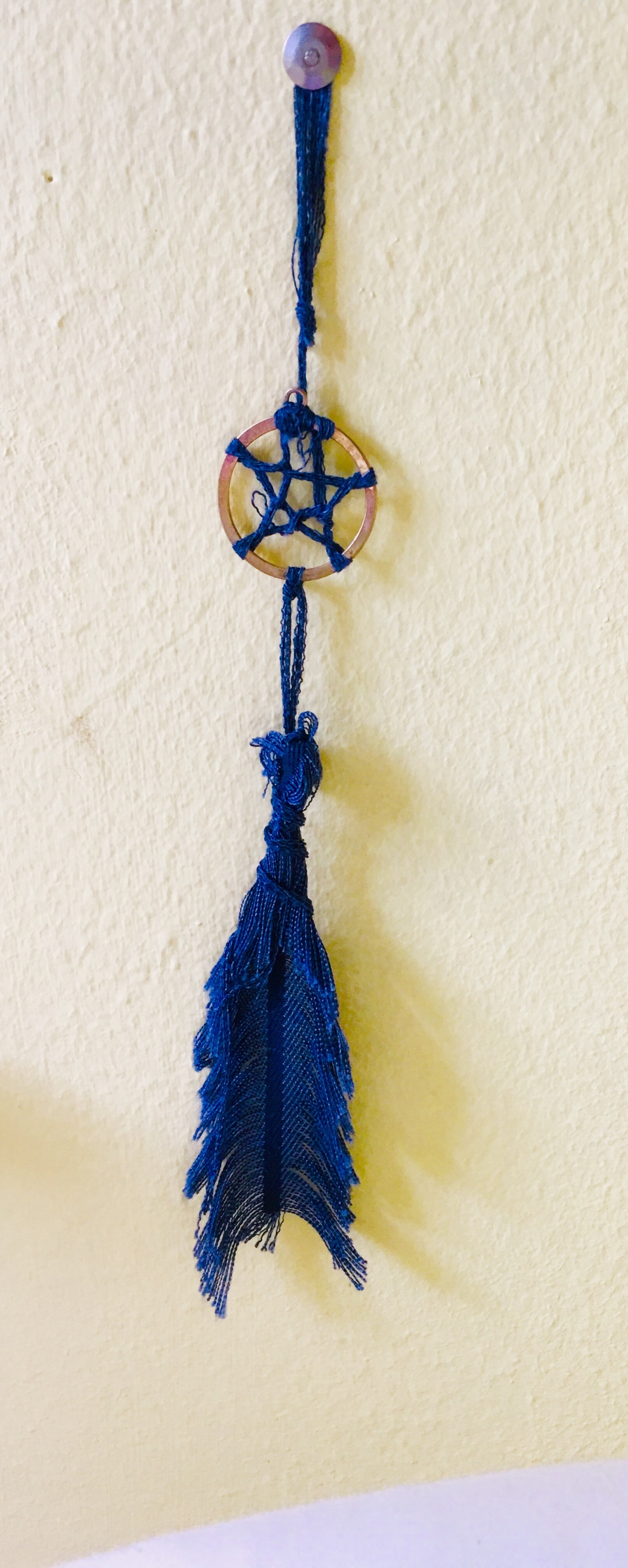
A handful of years ago, I found myself waiting on a bench at a bus stop in MA, when a weathered, maybe young, maybe middle-aged man sat down next to me. We soon struck up a conversation, as I was curious about the assortment of craft materials he was pulling out of his bag. He proceeded to tell me a considerably involved story about how his ex-wife had kicked him out of the house and out of his daughter’s life, and how he had been homeless and couch surfing on-and-off for some time. In the course of these nomadic years, he had discovered how to create dreamcatchers from materials he gathered on the streets. He used thread unraveled from an old pair of jeans, washers dug out of the trash, and bits of feathers and bling found along the road. I had always wanted to make my own dreamcatcher, and as he talked, he also began to teach me. He generously shared his materials and assisted me in creating this simple design:

When it was time for us to go our separate ways, we said goodbye with a hug. I was thankful for the gift, and he was grateful for the listening. He smelled strongly of the streets, and I could intuit from his story that he had not treated his loved ones well in the past. This was not a person I would invite further into my life. And yet, I will never forget him or his patient teaching. I won’t forget his resourcefulness, how he made beauty out of what the rest of us throw away, how he learned from and connected to an indigenous tradition that goes back countless generations. The dreamcatcher we made together still hangs next to my bed and catches my dreams years later. 

Here’s the other side of the story: he wasn’t yet able to take responsibility for the pain he had caused. He still blamed other people for his own destructive behavior. From what I could gather, there was good reason for his ex-wife to not tolerate contact by him. Was this a bad person who could do some art? Was this an artist who had done bad things? My answer is this: we are all everything. We contain all the shadow and all the light there can possibly be. Instead of judging ourselves or others, can we receive and appreciate the true gifts while also establishing clear boundaries where we need them? Can we invite the compassionate heart that also knows how to say no? 

Humans are messy and paradoxical. Each one has a jewel inside, rare and beautiful. Each one casts a shadow, dark and sometimes hurtful. Love means committing to seeing the light, and it means stepping away when we need to. Finding the proper distance from which we can feel compassion is a delicate dance. But one worth every song.

If you’re having trouble negotiating closeness and distance in relationships with other complex human beings, you are not alone. Support is available here, not to tell you what to do but to redirect you towards your own intuition and wisdom on these matters. Maybe you’ll even find the answers you need on the streets or in a dream. If you ask for help, it is sure to arrive somehow.

With love,

Julia Aziz

Sign up for reflections like this in your inbox.

Trapped in the Head and the Doorway to Freedom

When I was 21, I discovered Buddhism and vipassana meditation. I was often anxious and worried, so it wasn’t about seeking enlightenment; it was about finding a way to actually enjoy being a person. In learning how to compassionately witness my over-stimulated nervous system, I didn’t change who I was as much as I became much better at being with myself no matter what was going on inside. 

In the fall of 2000, I traveled to Thailand and Nepal because I wanted to dive deeper into meditation practice closer to its source. I spent nine days of my first ten day silent retreat in complete resistance. I wanted to get out of there so badly. I loved the silence. I could have happily lived in silent community for months. But everything hurt. My body loves to move, and sitting still in the half-lotus position was killing me. My mind was also obsessing like crazy. All I could think about was (1) my pain (2) how I could possibly escape early and (3) why coming here was my worst idea ever. These thoughts led, of course, to many other miserable thoughts of past mistakes and future worries. I continued trapped in this mental prison for nine days without distractions, as we alternated sitting and very slowly walking from 4am to 10pm every day. 

On the ninth day, the teachers announced that we would only be having one meal instead of our usual two. It would be a 24-hour fast, and it would give us more time for sitting. Pushed to the limit, I finally landed at the bottom of all that fierce resistance. What I discovered there was absolute, pure joy. I had fought a losing battle through every dark feeling there was to feel, and when I finally gave up the fight, all that was left was bliss. All the more so because nothing on the outside had actually changed. I still had to sit in this uncomfortable position for 18 hours on and off all day. But I was happy anyway. This was freedom.

Anxiety, worry, and overwhelm can be a doorway, as can all the things we struggle with. When we’re stressed out enough, we are often more open to trying new things. Meditation is, of course, only one of many tools that help. I am profoundly grateful to have been exposed to so many wonderful teachers and practices over the years. I love to share them because I know they’ve helped me. 

These times are full of struggle, and that is why they are also ripe for awakening. Have you experienced your own suffering as a doorway to freedom? What’s helped you? I don’t believe everyone needs to learn how to sit still for hours. That’s not the point. The point is to be willing to experience everything that this human life has to offer. To stay with it all, as it comes. To surrender, one little moment at a time.

With you in the journey of human-hood,

Julia Aziz

PS — Here’s a few simple tools to help along the way.